

In 2022, landlords in Vancouver were fielding 30 applications for a single unit. In Toronto, tenants were waiving move-in inspections, offering above-asking rent — in writing — just to get a lease signed. In Calgary, vacancy rates dipped so close to zero that property managers stopped bothering with vacancy reports because there was nothing to report. Rents were climbing 8%, 10%, 12% annually across the country, and anyone holding Canadian rental real estate felt like a genius.
That market is gone.
Canada’s average asking rent hit $2,027 in April 2026 — down 4.7% from a year ago and falling for the 19th consecutive month. Rents in Vancouver are 19.4% below their September 2023 peak. Toronto rents have sunk to their lowest point since May 2022. Calgary vacancy has climbed to 5.8%, a figure that would have seemed fictional to anyone who owned property there two years ago. And landlords in markets where applicants once outnumbered units 30-to-1 are now offering free rent, moving allowances, and lease-signing bonuses just to fill vacancies.
None of this means Canadian rental real estate is broken. It means the market reset — and understanding the anatomy of that reset is the difference between making good decisions in 2026 and making expensive ones.
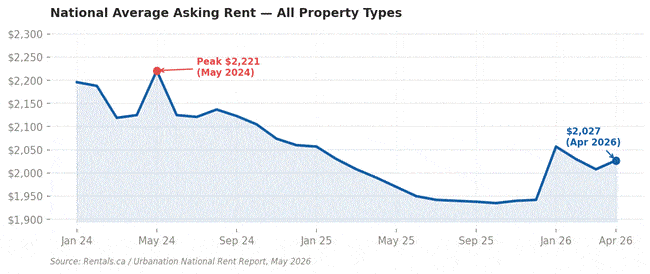
Source: Rentals.ca / Urbanation National Rent Report, May 2026
How A Perfect Storm Became A Perfect Correction
The current rental market didn’t happen by accident. Three forces converged at precisely the wrong time for landlords, and getting the timing right on when those forces ease is the central question every investor should be asking.
Supply. The construction boom that started during the pandemic rental surge took several years to work through the pipeline, and those units are landing right now. According to CMHC’s Spring 2026 Housing Supply Report, rental units under construction in 2025 reached nearly twice the 10-year average. Rental starts hit record highs in Calgary, Edmonton, Ottawa, Halifax, and Montreal, and reached their second-highest level on record in Toronto. Developers who locked in projects during the 2021–2023 boom — when vacancy rates were near zero and annual rent growth was in the double digits — are now delivering into an entirely different market.
Immigration. Canada’s pivot on temporary resident targets has had a direct and disproportionate impact on rental demand, because international students and foreign workers rent at far higher rates than the general population. RBC Economics reports that net new non-permanent residents dropped sharply in 2025, and the bank expects population growth to stall almost entirely in 2026. Ontario and British Columbia — historically the primary destinations for temporary arrivals — have absorbed the demand loss most acutely, which explains why rents in Toronto and Vancouver are falling fastest.
Household formation. A weaker labour market, particularly for younger Canadians, has quietly suppressed demand in ways that don’t show up cleanly in the headlines. When young workers can’t find stable employment, they stay in shared housing longer, move back home, or delay forming independent households. The result is a smaller pool of active renters chasing a larger pool of available units.
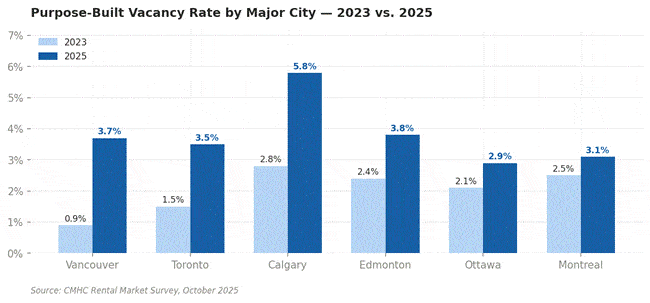
Source: CMHC Rental Market Survey, October 2025
The National Picture, City by City
Average national figures are a starting point, not an investment thesis. The spread between Canada’s weakest and strongest rental markets right now is wider than it’s been in over a decade, and the regional story is where the real intelligence lives.
Vancouver
No major Canadian city has seen a more dramatic reversal. Apartment rents fell 5.3% year-over-year in April, with one-bedroom units down 7% to $2,358 and three-bedrooms down 7.7% to $3,876. Rents have declined on an annual basis for 29 consecutive months. CMHC’s October 2025 survey found Vancouver’s vacancy rate at 3.7% — the highest level since 1988. A market that was functionally impossible to rent into three years ago now has vacancy levels not seen in nearly 40 years. For the first time in recent memory, Vancouver landlords are offering incentives: free rent, moving allowances, signing bonuses. CMHC expects Vancouver’s completed rental pipeline to remain substantial through 2027.
Toronto
Toronto rents are at their lowest level since May 2022 — a 46-month low — following 26 consecutive months of year-over-year declines. Two-bedroom apartment rents fell 8.3% year-over-year. Bachelor suite vacancy reached 8.9% in the city, well above the national average. Notably, purpose-built rental starts actually exceeded condominium starts in the City of Toronto recently — a historic shift in the construction mix. CMHC forecasts rental apartment construction to decline in the second half of 2026.
Calgary
Calgary’s correction has been sharp and fast. Vacancy climbed to 5.8% — the highest of Canada’s six largest markets — after years of sub-1% tightness. Average apartment rents fell 5.3% year-over-year in April. Alberta operates without rent control, which means rents can fall quickly in a softening market — and recover quickly when conditions turn. By October 2025, average asking rents in Calgary represented 23.2% of median renter household income, comfortably below the CMHC affordability threshold of 30%. Calgary’s vacancy dropped 90 basis points quarter-over-quarter, suggesting stabilization is already underway.
Edmonton
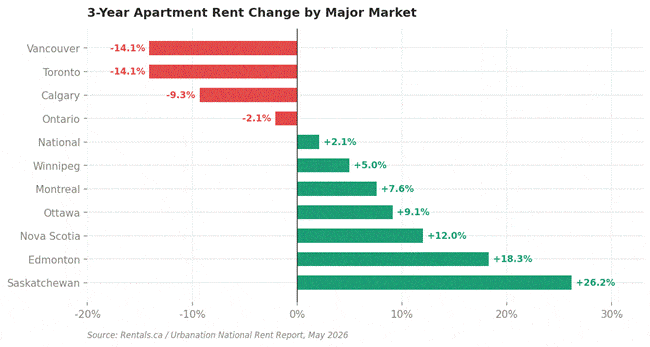
Edmonton is arguably the most resilient major rental market in Canada right now. Average apartment rents are down just 1.2% year-over-year — the smallest annual decline of any of Canada’s six largest cities — and purpose-built rents sit at approximately $1,603 per month. Over the past three years, Edmonton rents are still up nearly 19%, the strongest three-year performance among Canada’s major markets.
Montreal and Quebec
Montreal is one of the few large cities in Canada where rents are still growing across most unit types. One-bedroom units rose 0.8% year-over-year in March, two-bedrooms rose 2.1%, and three-bedroom apartments increased in both Montreal and Quebec City. Quebec’s purpose-built rental pipeline is the most active in the country relative to its market size, yet demand has absorbed new supply without the oversupply conditions seen further west.
The Prairies and Atlantic Canada
Saskatchewan has quietly become the strongest rental market in Canada over the past three years. Apartment rents rose 3.7% year-over-year in March 2026 and have climbed 26.2% over three years — the best three-year performance in the country. Manitoba showed 3.4% annual apartment rent growth. Nova Scotia rounds out the outperformers: average apartment rents rose 3.9% year-over-year, and Halifax vacancy remains among the tightest nationally at 2.8%.
Market snapshot — April 2026
| Market | Avg. Asking Rent | Year-over-Year |
| National | $2,027 | −4.7% |
| Vancouver | $2,679 | −5.3% |
| Toronto | $2,508 | −5.0% |
| Calgary | $1,844 | −5.3% |
| Edmonton | $1,603 | −1.2% |
| Montreal | $1,981 | +1.0–2.1% |
| Ottawa | $2,190 | +3.0% (3-bed) |
| Nova Scotia | $2,284 | +3.9% |
| Saskatchewan | $1,385 | +3.7% |
Purpose-Built vs. Condo: Understanding The Gap
The correction has not treated all rental product equally, and understanding the difference matters enormously for how investors assess risk right now.
Purpose-built rents declined 3.7% year-over-year in April to an average of $2,027 per month — a meaningful pullback, but significantly more stable than the condo rental segment, where asking rents fell 5.6% year-over-year. Houses and townhomes have seen the sharpest declines of all, down 6–8% in many markets.
Over the past three years, purpose-built rents nationally are still up 24.6%, while condo apartment rents have risen just 1.6%.
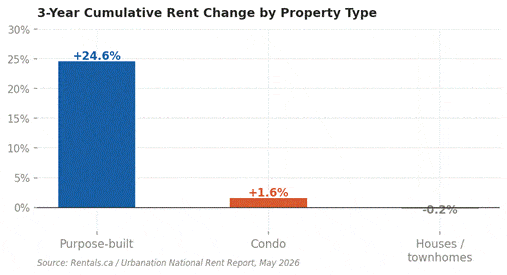
Source: Rentals.ca / Urbanation National Rent Report, May 2026
Condo investors who purchased pre-construction units during the 2021–2024 boom are now competing in the most price-sensitive segment of an already oversupplied market. In Toronto and Vancouver particularly, the pipeline of investor-owned condos entering the rental market added competitive pressure that purpose-built operators didn’t face from within their own asset class.
For investors evaluating acquisitions, the asset class distinction should factor explicitly into underwriting. A purpose-built building in a supply-constrained market tells a different story than a condo unit in a building full of similar units all trying to find tenants.
What Affordability Data Is Actually Telling Us
Falling rents get the headlines, but the affordability data carries a more interesting signal. Even after 19 consecutive months of declines, average Canadian asking rents remain 21.9% above the pandemic-era low of April 2021. The correction has unwound a portion of the 2022–2024 surge, but rents are not cheap by historical standards.
What has changed is the relationship between rents and incomes. Statistics Canada data shows nominal average weekly earnings rose 11.7% nationally between October 2022 and October 2025. In Calgary and Edmonton, average asking rents now represent 23.2% of median renter household income — well within the CMHC affordability benchmark of 30% of pre-tax income. Vancouver remains a different universe: even at current discounted rents, a one-bedroom apartment still effectively requires a six-figure household income to clear the affordability threshold.
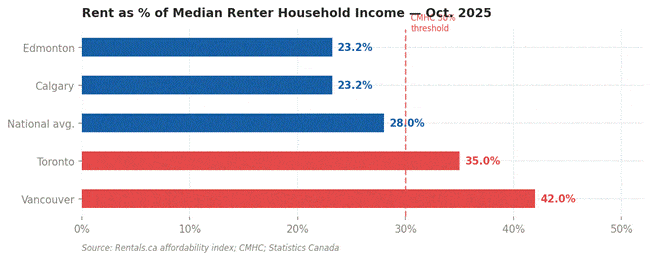
CMHC affordability threshold: 30% of pre-tax household income. Source: Rentals.ca affordability index; CMHC; Statistics Canada
The Supply Cycle Is Already Turning
The current rental market is the product of a construction cycle that peaked in 2023–2024. That cycle is now turning. CMHC’s Spring 2026 Housing Supply Report confirms that purpose-built rental starts have declined meaningfully as rising vacancies and deteriorating project economics have caused developers to pull back. Projects that pencilled out when rents were climbing 10% annually no longer work at current rent levels.
The supply correction is a lagging force — units started in 2022 and 2023 are still delivering today, which is why vacancy rates continue climbing in some markets even as starts fall. But the slowdown in new starts is real, and it sets up a meaningfully different supply picture by 2027 and 2028. Average apartment cap rates have expanded into the mid-4% range nationally — up from the sub-4% levels that defined the peak. For investors with medium-to-long time horizons, the entry conditions in 2026 look considerably more attractive than anything available during the 2021–2024 run-up.
Where This Market Goes From Here
April’s Rentals.ca data contained one detail worth flagging: for the first time since September 2025, one-bedroom and two-bedroom rents increased on a monthly basis simultaneously. The annual rate of decline also decelerated for the fifth consecutive month. Neither data point signals a recovery — but they do suggest the correction is losing momentum.
Urbanation president Shaun Hildebrand put it plainly: improving affordability “should help bring renters into the market who were priced out in recent years.” That’s the basic economics of what happens when rent-to-income ratios return to reasonable levels after years of being stretched.
The rental market that emerges from this correction will look different from the one that preceded it. Developers who pulled back during the softness will eventually return — but with a thinner pipeline and higher cost structures that will make new supply harder to deliver. Markets like the Prairies and Atlantic Canada that held their ground during the correction will likely see that performance continue. Markets like Toronto and Vancouver will recover, but the timeline depends heavily on whether immigration targets rebound — and that remains a political variable as much as an economic one.
What won’t change is the structural reality that Canada is short of housing on a per-capita basis, that purpose-built rental construction is barely keeping pace with long-term demand, and that an entire generation of renters is entering their prime household-formation years. The investors who treat 2026 as a buying window — rather than a reason to sit on the sidelines — may have history on their side.